As an Amazon Associate this site earns from qualifying purchases.
Quick Picks
| Product | Stated size | Best for | Link |
|---|---|---|---|
| How To Choose The Right Picture Frame (How to Frame Book 5) | Not stated in the listing record | Readers who want framing vocabulary before spending | Check Price on Amazon |
| Quadro Frames 6x8.5 inch Picture Frame | 6x8.5 inch, black, 3/8 inch wide molding | Odd-size prints and book-page art | Check Price on Amazon |
| Quadro Frames 8.5x17 inch Picture Frame | 8.5x17 inch, black, 3/8 inch wide molding | Panoramic crops and tall vertical strips | Check Price on Amazon |
| Framed Canvas Prints With Your Photo-Personalized Picture To Canvas Wall Art | Not stated in the listing record | Skipping frame sizing entirely | Check Price on Amazon |
| How to Choose The Right Preschool Poster Parent's Guide Wall Art Canvas for Bedroom Living Room Decor 08x12inch(20x30cm) Frame-style | 8x12 inch (20x30 cm), frame-style | Small filler slots in a gallery wall | Check Price on Amazon |
| How to Choose The Right Preschool Poster Parent's Guide Wall Art Canvas Painting for Living Room Bedroom Decor 24x36inch(60x90cm) Unframe-style | 24x36 inch (60x90 cm), unframed | A large anchor piece you frame yourself | Check Price on Amazon |
Disclosure: We earn a small commission from qualifying Amazon purchases at no extra cost to you.
As an Amazon Associate, we earn from qualifying purchases.Last Updated: September 2026
Learning how to choose the right picture frame size is mostly a matter of learning three numbers: the size of your print, the size of the frame's opening, and the size of the finished outside edge. Get those three straight and almost every framing problem disappears. Get them confused and you end up with a 5x7 photo cropped inside a 4x6 opening, or a mat that swallows the faces in a family portrait.
Here's the thing: frame sizing is one of the few home-decor decisions that is genuinely arithmetic. There is a right answer. This guide walks through print-to-frame matching, matting math, gallery wall spacing, collage frame sizing tips, and the nonstandard sizes that trip people up, and it uses real listings on Amazon as concrete examples of what a spec sheet does and does not tell you.
One thing to be upfront about: this website does not do product research. Nobody here hung, handled, measured or assembled any of the products below. Everything specific stated about a product comes from its Amazon Creators API verified product record and its retailer listing, both retrieved 2026-09-05, and you will see exactly which figure came from where.

- ASSEMBLY IS REQUIRED. Gallery style side loading frame. High precision components snap together quickly and without tools
- Frame Kits include 1/8" thick MDF backing panel, 0.040" thick clear PET facing panel and molding set with concealed corner connectors for assembly and hanging

- ASSEMBLY IS REQUIRED. Gallery style side loading frame. High precision components snap together quickly and without tools
- Frame Kits include 1/8" thick MDF backing panel, 0.040" thick clear PET facing panel and molding set with concealed corner connectors for assembly and hanging

- Design Your Own Canvas Prints: We combine your best memories captured in photos with our state-of-the-art technologies and materials to create breathtaking and unique wall
- Image resolution: more than 75 DPI proposed. To achieve good results, the resolution of your digital camera should not be lower than 4 megapixels. For best resolution quality
- NOTE: All poster prints may vary slightly from what you see on your screen due to the resolution and colour profile of your device. These prints look AMAZING when displayed in a
- HIGH QUALITY: The posters is made shortly after purchase. It is not stored in the warehouse because its color will be unsatisfactory due to the storage environment. They are

- NOTE: All poster prints may vary slightly from what you see on your screen due to the resolution and colour profile of your device. These prints look AMAZING when displayed in a
- HIGH QUALITY: The posters is made shortly after purchase. It is not stored in the warehouse because its color will be unsatisfactory due to the storage environment. They are
The Three Measurements That Actually Matter
Before anything else, learn the vocabulary. Nearly every sizing mistake comes from treating these three numbers as one number.
- Print size. The dimensions of the paper or canvas itself. A "4x6 photo" is 4 inches by 6 inches of paper.
- Frame opening (or mat window). The visible area. This is almost always slightly smaller than the print, because the frame lip or mat overlaps the edges to hold the print in place. That overlap is why a print sized exactly to the opening will show white slivers if it shifts.
- Outside dimension. The footprint on your wall, including the molding. This is the number that decides whether three frames fit above your sofa.
Types of Picture Frames Explained
| Frame type | How sizing works | Strength | Weakness |
|---|---|---|---|
| Standard-size frame (4x6, 5x7, 8x10, 11x14) | Buy to match a common print size | Cheapest, easiest to replace, mats widely available | Forces you to crop anything shot at a different ratio |
| Nonstandard / odd-size frame | Buy to match an unusual print, like 6x8.5 or 8.5x17 | Fits documents, book plates and panoramas without cropping | Off-the-shelf mats and replacement glass are harder to source |
| Matted frame | Frame outside dimension is larger than the artwork | Adds visual breathing room, protects the print surface from glazing | The mat window, not the frame size, determines what you see |
| Collage / multi-opening frame | One outer frame, several fixed openings | Instant symmetry, one hanging point | Your photos must match the fixed openings exactly |
| Pre-framed canvas | Sizing decided at order time | No mat math, no glass, no assembly | You cannot reframe it later without redoing the piece |
| Unframed canvas or poster | You supply the frame | Cheapest way to cover a large wall | Large sizes need custom framing, which can cost more than the art |
4x6 vs 5x7 Picture Frames: The Ratio Problem
Short answer: 4x6 and 5x7 are not the same shape, so a 5x7 print will not simply "fit smaller" inside a 4x6 frame. The arithmetic is straightforward. Divide the long side by the short side and 4x6 gives 1.5, while 5x7 gives 1.4. That difference of a tenth is enough to leave one dimension short when you swap prints between them.
Most phone cameras and most drugstore prints default to the 1.5 shape, which is why 4x6 dominates photo albums and desk frames. The 1.4 shape of 5x7 is closer to square, so portraits framed at 5x7 read a little calmer and a little more formal. Neither is better. They are different crops of the same photograph.
Practical rule: if your photos come off a phone or a DSLR untouched, buy 4x6 frames and stop thinking about it. If you are printing a portrait you want to feel deliberate, print at 5x7 and buy the frame to match that print, not the other way around.
8x10 Frame With Mat Measurements
An 8x10 frame with a mat almost always means an 11x14 outside frame holding an 8x10 window. That is the classic combination, and understanding why explains all mat math.
A mat is a border. If you want a 2 inch mat around an 8x10 print, you add 2 inches to each of the four sides: 8 plus 2 plus 2 equals 12, and 10 plus 2 plus 2 equals 14. So a 12x14 frame. Shrink to a 1.5 inch mat and you get 11x13. The common 11x14 sizing is a compromise that gives an 8x10 print a mat of roughly 1.5 inches on the sides and 2 inches top and bottom.
The subtlety worth knowing: the mat window is cut slightly smaller than the print, typically by about a quarter inch on each side, so the mat overlaps and holds the paper. That means an "8x10 mat opening" shows a little less than the full 8x10. If your photo has important detail near the edge, size up.
Gallery Wall Frame Layout
A gallery wall is a spacing exercise more than a sizing exercise. Three rules do most of the work.
- Pick one constant. Either every frame shares a color and molding width, or every frame shares a size. Varying both at once reads as clutter.
- Keep the gaps uniform. Two to three inches between frames is the conventional range for a tight modern grid; wider gaps make the wall feel sparse and drift toward looking accidental.
- Anchor with one large piece. A single 24x36 canvas or poster gives the eye somewhere to land, and smaller 8x12 or 5x7 pieces orbit it.
- Lay it out on the floor first. Trace each frame's outside dimension on paper, tape the shapes to the wall, and only then reach for a hammer.
If you are building a mixed digital and print wall, our companion pieces on gallery wall frame layout and Wi-Fi digital photo frame sizing cover how a screen sits alongside paper.
Key Features to Look For, Ranked
- A stated opening size, not just a marketing size. The single most useful line in any frame listing.
- Molding width. It sets both the outside dimension and the visual weight. A narrow molding disappears; a wide one competes with the art.
- Glazing material. Glass is clearer and scratch-resistant; acrylic is lighter and safer near children. Many listings do not state which they use, and that omission is itself information.
- Orientation hardware. Whether the frame hangs portrait, landscape, or both.
- Depth. Matters only if you are framing something with thickness, like a pressed flower or a jersey.
- Color and finish. Last, honestly. Black works with nearly everything, which is why it is the default in so many catalogues.
Common Mistakes to Avoid
- Buying the frame before the print. Print first, measure, then buy. Reversing this is the number one cause of cropped heads.
- Assuming "8x10 frame" means an 8x10 outside dimension. With a mat it usually does not.
- Ignoring molding width in a grid. Six frames each 3/8 inch wider than planned add up to more than four inches across a row.
- Hanging at eye level for you. Center the artwork around 57 to 60 inches from the floor so it works for everyone in the room.
- Buying a nonstandard size without checking mat availability. Odd sizes solve a fit problem and create a sourcing problem.
- Skipping wall-anchor ratings for heavy pieces. Large framed glass is heavy. General consumer product safety information and recall notices are published by the U.S. Consumer Product Safety Commission at cpsc.gov, and broader consumer protection guidance is published by the federal government at usa.gov.
Budget Considerations
We never quote dollar amounts, because Amazon pricing moves constantly and a stale number is worse than no number. Check the current price on Amazon for anything below. What we can describe is what each tier buys you.
Good. A single mass-produced frame in a standard size with a thin molding, sold in one color. You accept whatever glazing the manufacturer chose, and you accept that the listing may not tell you what it is. Fine for hallway snapshots and kid art you will swap out every few months.
Better. A frame built to an odd size so your print does not have to be cropped, or a matted frame where the mat window is published rather than implied. This tier is worth paying for when the print is one of one, such as a document, a book plate or a panoramic crop.
Best. A finished piece where sizing is decided before it ships, such as a made-to-order framed canvas, or a genuinely large statement piece framed properly. The cost here is not the frame, it is the labor and the fact that a mistake is not returnable.
Our Top Recommendations
Six products are covered below. Two are actual picture frames, one is a personalized framed canvas, two are wall-art canvases whose value here is that they publish exact dimensions, and one is a book. That mix is deliberate, and each section says plainly what the product is so nobody buys a poster expecting a frame.
Quadro Frames 6x8.5 inch Picture Frame — Best for odd-size prints that standard frames will not fit
The Amazon Creators API verified product record retrieved 2026-09-05 lists this product as "Quadro Frames 6x8.5 inch Picture Frame, Black, Style P375-3/8 inch Wide Molding," which puts the stated frame size at 6x8.5 inches in black with a molding described as 3/8 inch wide. That combination is the interesting part. A 6x8.5 opening is not a photo-lab standard, which strongly suggests this exists for things photo-lab sizes cannot hold: book pages, small documents, trimmed art prints, certificates that were never 8x10.
The 3/8 inch molding is narrow. Reading that number forward, a slim profile means the frame's outside dimension stays close to the artwork, which is what you want when you are lining up several frames in a tight grid and every extra fraction of an inch compounds across the row.
Pros
- Publishes an exact frame size, 6x8.5 inches, in the product title itself
- Narrow 3/8 inch molding keeps the outside footprint close to the art
- Black finish is the safest default in a mixed gallery wall
- The listing record does not state the glazing material, the mounting hardware, or whether the frame hangs both portrait and landscape
- A 6x8.5 opening is not a common mat size, so sourcing a matched mat later is on you
- No matting is described, so a print sized exactly 6x8.5 will lose a sliver under the lip
Quadro Frames 8.5x17 inch Picture Frame — Best for panoramic crops and tall vertical strips
The Amazon Creators API verified product record retrieved 2026-09-05 lists this product as "Quadro Frames 8.5x17 inch Picture Frame, Black, Style P375-3/8 inch Wide Molding," giving a stated 8.5x17 inch size in black with the same 3/8 inch wide molding. Run the arithmetic on 8.5 by 17 and you get exactly 2:1, a double square. That is the shape of a panorama, a triptych strip, or a tall stairwell column.
Look, a 2:1 frame is a commitment. Nothing you shot in a normal aspect ratio drops into it without a hard crop. But if you already have a panoramic image, this is far cheaper than custom framing, and the shared 3/8 inch molding and black finish mean it pairs cleanly with the 6x8.5 frame above in the same wall arrangement.
Pros
- Exact 2:1 proportion at a stated 8.5x17 inches, which standard catalogues rarely stock
- Matches the 6x8.5 model's black finish and 3/8 inch molding for a consistent grid
- Long format works for stairwells and above-door spaces that standard sizes leave awkward
- The listing record does not state glazing material, backing, or hanging hardware
- Only useful if your image is already cropped near 2:1; otherwise you are cutting the picture
- Long thin frames are inherently more awkward to hang level than compact ones, and no hanging system is described in the listing
Framed Canvas Prints With Your Photo-Personalized Picture To Canvas Wall Art — Best for skipping frame sizing entirely
The Amazon Creators API verified product record retrieved 2026-09-05 lists this product as "Framed Canvas Prints With Your Photo-Personalized Picture To Canvas Wall Art," a personalized framed canvas made from a photo you supply. The appeal for anyone struggling with sizing is obvious: there is no mat window to calculate, no glazing to choose, and no gap between print size and opening size, because the print and the frame are produced together.
Honestly, that convenience is also the catch. A made-to-order piece is sized at checkout, so the decision moves earlier rather than disappearing. You still need to know what dimensions your wall wants before you order.
Pros
- Removes the print-versus-opening mismatch that causes most framing errors
- Personalized from your own photo, so it suits one-of-one images rather than stock art
- Canvas needs no glass, which matters in rooms with strong window glare
- The listing record does not publish dimensions, canvas thickness, frame depth or resolution requirements for the uploaded photo
- Personalized items are generally difficult to return, and no return terms appear in the record
- You cannot reframe a printed canvas later the way you can swap a paper print between frames
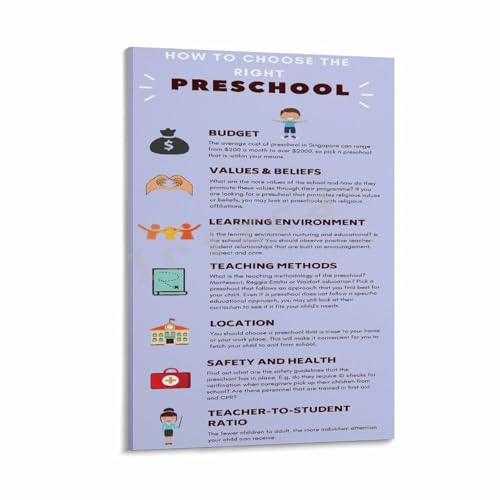
How to Choose The Right Preschool Poster Parent's Guide Wall Art Canvas for Bedroom Living Room Decor 08x12inch(20x30cm) Frame-style — Best for filling a small slot in a gallery wall
Be clear about what this is: wall art, not a frame. The Amazon Creators API verified product record retrieved 2026-09-05 lists it as "How to Choose The Right Preschool Poster Parent's Guide Wall Art Canvas for Bedroom Living Room Decor 08x12inch(20x30cm) Frame-style," which states an 8x12 inch, or 20x30 cm, canvas in a frame-style presentation.
Why include it in a sizing guide? Because 8x12 is the 2:3 shape, the same 1.5 ratio as a 4x6 photo scaled up. That makes it a useful reference object: if you are planning a wall around phone photos, an 8x12 piece sits in the same visual family, and the stated centimetre conversion is handy when your other art was sourced in metric.
Pros
- Publishes an exact size in both inches and centimetres, 8x12 inch and 20x30 cm
- The 2:3 proportion matches standard photo crops, so it groups naturally with 4x6 and 6x9 prints
- Small footprint suits the filler positions in a gallery wall arrangement
- It is a printed canvas, not a picture frame, and cannot hold your own photograph
- "Frame-style" is not defined in the listing record, so the material and depth of that framing are unknown
- The subject matter is a preschool-choosing guide poster, which is a narrow fit for most living rooms despite the listing naming them
How to Choose The Right Preschool Poster Parent's Guide Wall Art Canvas Painting for Living Room Bedroom Decor 24x36inch(60x90cm) Unframe-style — Best for a large anchor piece you frame yourself
Same caveat: wall art, not a frame. The Amazon Creators API verified product record retrieved 2026-09-05 lists this as "How to Choose The Right Preschool Poster Parent's Guide Wall Art Canvas Painting for Living Room Bedroom Decor 24x36inch(60x90cm) Unframe-style," stating a 24x36 inch, or 60x90 cm, canvas supplied unframed.
Here is where the sizing lesson lands. 24x36 is also a 2:3 shape, exactly three times the 8x12 version above in each dimension, which means the two hang together in proportion. Unframed at that size, though, you are now shopping for a 24x36 frame, and large frames are where framing budgets go to die. Factor that in before comparing it to the framed option.
Pros
- Large stated size, 24x36 inch and 60x90 cm, gives a gallery wall the anchor piece it needs
- Shares the 2:3 proportion of the 8x12 version, so the two scale together cleanly
- Shipping unframed usually means shipping rolled, which reduces the risk of a damaged corner
- No frame included, and a 24x36 frame is a real additional cost you must budget separately
- The listing record does not state canvas weight, thickness, or whether it arrives rolled or flat
- Large unframed canvas can ripple or curl before it is stretched or mounted, and no mounting method is described
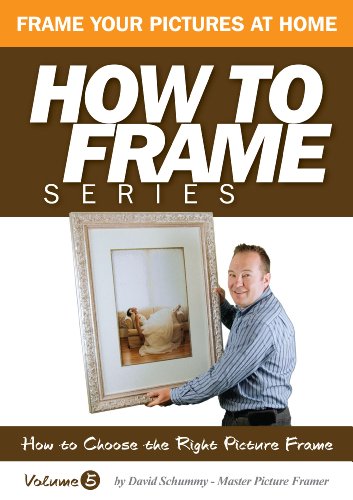
How To Choose The Right Picture Frame (How to Frame Book 5) — Best for learning the vocabulary before you spend
The Amazon Creators API verified product record retrieved 2026-09-05 lists this title as "How To Choose The Right Picture Frame (How to Frame Book 5)," the fifth entry in a How to Frame series. It is a book, not a frame, and it belongs in this guide only as a reference purchase for someone framing enough pieces that the terminology is worth internalising.
If you are hanging two photos in a hallway, skip it. If you are framing a dozen pieces, a reference that explains mat proportion and molding weight in one place saves more than it costs.
Pros
- Focused squarely on frame selection rather than general decorating
- Part of a numbered series, which suggests a structured rather than one-off treatment of the topic
- A reference you keep applies to every future frame purchase, unlike a single frame
- It is a book and will not hang anything on your wall
- The listing record does not state page count, publication date, or format details
- No table of contents or sample is described in the record, so the depth of coverage is unverifiable from the listing alone
How We Research
Every product fact on this page traces to one of two source types: the Amazon Creators API verified product record for each ASIN, and the corresponding Amazon retailer listing. Both were retrieved 2026-09-05.
The method is close reading rather than handling. We take what the listing publishes, mainly the stated dimensions and finish in each product title, and reason forward from it: what a 3/8 inch molding does to a grid's total width, what a 2:1 frame demands of your crop, what an unframed 24x36 canvas implies about your remaining budget. Where a listing is silent, we say it is silent rather than filling the gap.
No product on this page was assembled, hung, weighed or otherwise handled by anyone here. This website runs no lab and performs no physical testing.
How to Get the Best Deal on Amazon
- Check the size variant, not just the product page. Multi-size listings often price sizes very differently, and the default selection is not always the one you want.
- Compare framed against unframed for the same artwork. The 8x12 frame-style and 24x36 unframe-style listings above are the same design at different sizes and framing states; the cheaper line item is not always the cheaper wall.
- Buy grid frames in one order. Molding and finish vary between production runs, and matching matters more in a grid than in isolation.
- Read the question-and-answer section for missing specs. When a listing does not state glazing or hardware, previous buyers frequently have.
- Check the current price the day you buy. We deliberately publish no dollar figures, because they go stale within days.
Maintenance and Care Tips
- Dust with a dry microfiber cloth. Never spray cleaner directly at a frame; liquid wicks under the glazing and reaches the print.
- Keep prints off walls in direct sun. Ultraviolet light fades ink regardless of what the frame cost.
- Do not clean acrylic glazing with ammonia-based cleaner. It hazes. If a listing does not state whether the glazing is glass or acrylic, assume acrylic and treat it gently.
- Re-check hanging hardware yearly. Adhesive strips relax over time, especially in humid rooms.
- Store spare frames flat and separated. Stacked frames scratch each other at the corners.
Frequently Asked Questions
Final Verdict
If you are here to solve a fit problem rather than a decorating problem, the two Quadro listings are the substantive options on this page. The Quadro Frames 8.5x17 inch Picture Frame is the more interesting of the pair, because its stated 8.5x17 inch size is an exact 2:1 proportion that standard retail sizing simply does not offer, and that suits anyone with a panoramic crop or a narrow stairwell wall. Check Price on Amazon
For the more common problem, a print that is close to but not exactly a catalogue size, the Quadro Frames 6x8.5 inch Picture Frame covers a gap between 5x7 and 8x10 where book plates and small documents usually live, and its stated 3/8 inch molding keeps the outside dimension tight in a grid. Check Price on Amazon
And if the whole sizing exercise sounds like more effort than the project deserves, the Framed Canvas Prints With Your Photo-Personalized Picture To Canvas Wall Art removes the mat and opening math altogether by producing print and frame as one piece, at the cost of flexibility later. Check Price on Amazon
What we will not do is declare an overall winner across six products that are not the same kind of thing. A book, two posters, a canvas service and two frames do not compete; they solve different parts of the same problem.
More on this site: 4x6 vs 5x7 picture frames, 8x10 frame with mat measurements, and collage frame sizing tips.
Sources and Methodology
This page was built by reading listings, not by hanging frames. Nothing here was physically or laboratory-tested by this website, and no one on our side handled, assembled or measured any of the six items; every dimension quoted, from the 6x8.5 inch and 8.5x17 inch frame sizes to the 20x30 cm and 60x90 cm canvases, was taken from each product's Amazon Creators API verified product record and matching retailer listing as retrieved 2026-09-05, then checked for internal consistency against the arithmetic of standard photo ratios.
What that gets you is reliable in exactly one dimension and unreliable in others: published sizes and finishes for frame sizing are the kind of fact a listing states plainly and is accountable for, which is why this guide leans on them heavily. Durability, glazing clarity, corner joinery and packing quality are not stated in these records, so this page does not pretend to know them. For safety and consumer-rights questions that sit outside a product listing, the CPSC and USA.gov consumer protection pages are the appropriate references.